[
](https://substackcdn.com/image/fetch/$s_!uQBb!,f_auto,q_auto:good,fl_progressive:steep/https%3A%2F%2Fsubstack-post-media.s3.amazonaws.com%2Fpublic%2Fimages%2F48d143ab-f08e-40fc-aa4d-355303db15ea_1620x912.jpeg)
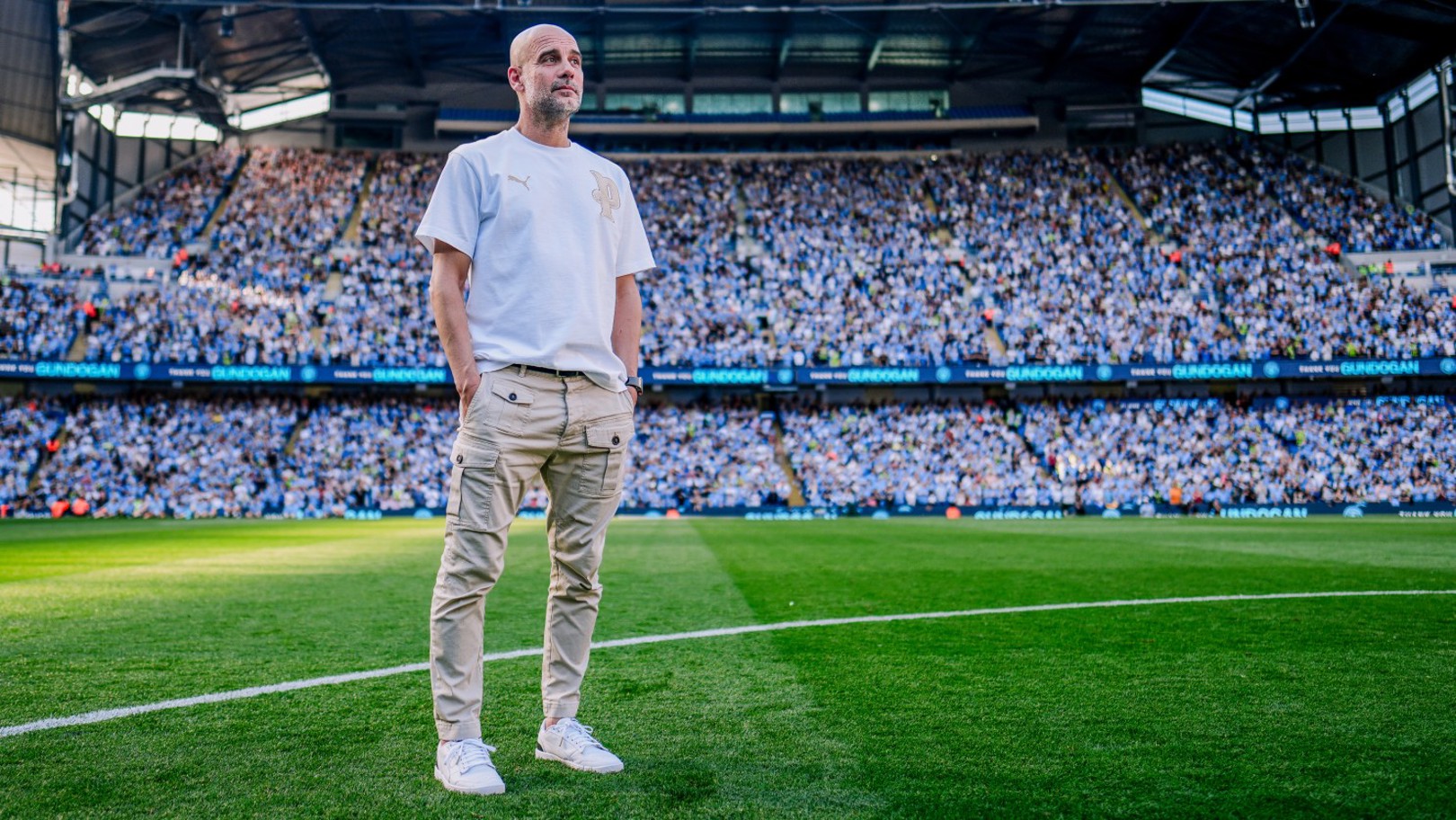
Watching one long-serving figure after another say goodbye at the Etihad, it was hard not to feel that Manchester City were losing something larger than personnel.
Pep’s fixer. Pep’s fitness coach. Pep’s lieutenant. Pep’s former captain. Pep’s former former captain. Pep’s favourite goalkeeper. Pep himself.
On and on it went. Not just departures, but relationships. Years of shared experiences, habits, instinct and mutual confidence walking out of the building at the same time.
That is what makes the next phase at City so fascinating and challenging. This is not simply a football problem. It is an organisational succession problem.
**All you need is trust**
Stephen Covey, in _The Speed of Trust_, argued that high-trust relationships reduce what he called transaction costs: the friction, second-guessing, internal politics and hidden drag that consume organisations operating at lower levels of confidence. In high-trust environments, speed goes up and cost comes down. Decisions take less time because people do not need to re-litigate motives, competence or alignment at every turn.
City under Guardiola, Txiki Begiristain, Ferran Soriano and Khaldoon Al Mubarak, were the football version of that idea.
This week, Guardiola himself kept returning to trust. Asked again about the Premier League charges, he did not reach for legal argument or procedural detail. He reached for relationships. “I trust them,” he said. “I spoke with them and trust how they behave and how they did.” It was a revealing answer because it was not really about the legal case at all. It was about the emotional basis on which he had operated for a decade. Guardiola’s public position has consistently been that he trusted the people above him and would wait for the resolution. Only the tardiness of the three panel members spoiled that plan.
That trust ran through the club in several directions at once. Downwards, from manager to players. Sideways, across Guardiola, Begiristain and Soriano. Upwards, towards Al Mubarak and the ownership. It was not merely that City had good executives or good coaches. It was that the key people believed in one another deeply enough to act with unusual speed and coherence.
The Tast Català story also says something real about trust. Guardiola, Soriano, Begiristain and CFG non-executive director Marty Edelman were among the figures behind the Catalan restaurant in Manchester. It closed in December 2025 after seven years, citing difficult trading conditions and rising costs but also giving an early symbolic nod to what ended yesterday. The restaurant was not important in itself but reinforces just how close these relationships have been.
Harvard professor John Kotter's work on leading change identifies the “guiding coalition” as the critical mechanism of transformation: the group of people with sufficient authority, credibility and mutual trust to sustain direction together. At City, that coalition of Al Mubarak, Soriano, Begiristain and Guardiola is now substantially dismantled along with a number of the support acts such as Buenaventura, Estiarte, and Mancisidor off the pitch and Bernardo, Gundogan and De Bruyne on it. What remains is Al Mubarak, Soriano for now, a new director of football in Hugo Viana who has been in post for eighteen months, and a manager who has not yet taken a session. The trust and guiding coalition has to be rebuilt between people who have not yet been through years of experiences together. That process cannot be accelerated by resource or goodwill alone.
**Ferguson, Wenger and the cost of losing trust**
United’s decline after Ferguson retired in 2013 is inexplicable when assessed by managerial quality alone. Moyes was experienced and highly regarded. Van Gaal had won titles across three countries. Mourinho had won the Champions League twice. Each failed comprehensively as did the others that followed. The real answer is that Ferguson with David Gill had been the key mechanism of trust at United for so long that the institution had forgotten how to function without them. What United retained when they left was the expectation of winning without the trusting internal relationships that had produced it. Thirteen years on, they have not won the title or even been close.
United did not have a succession in 2013, they had two vacancies. The consequences of confusing them are still visible today even though you can clearly see the attempt to rebuild a guiding and trusted coalition between Omar Barrada, Jason Wilcox and the ownership. Ruben Amorim’s difficulty in joining that coalition led to his rapid demise.
Arsenal’s lesson is different but equally relevant. Arsène Wenger left behind an identity, but that identity was deeply personal. Unai Emery inherited a club whose emotional and cultural habits had been formed over 22 years by one man. When the trust did not transfer, Emery’s authority did not transfer either.
Mikel Arteta’s eventual success is instructive precisely because he did not try to preserve Wengerism and because of the passage of time. He built something different and forced the club to live through the discomfort and the cost of his vision taking shape. The Özil and Aubameyang decisions were not just squad-management calls. They were decisions about trust and authority. Arteta was telling the dressing room that his culture was real and that no individual sat above it. The ownership, in turn, were telling the outside world that they trusted the manager enough to absorb the short-term pain and cost.
That may be the closest available model for City if the first phase after Guardiola is difficult. Not because City are Arsenal, or because Maresca is Arteta, but because genuine succession usually requires more than tactical continuity. It requires an institution to decide what must be preserved, what must be discarded and how much pain it is prepared to tolerate while the new structure forms and some individuals resist.
City are better placed than United were in 2013 and better placed than Arsenal were in 2018. Their infrastructure is real, the squad remains strong and the financial resources are enormous. And the ownership and Khaldoon has shown a level of patience and strategic consistency that is rare in elite football.
But it is still undeniable that a vast amount of the intangible has just left the building. The Premier League will not wait for City to process that loss.
**What Maresca must do**
Following Guardiola is, therefore, not just an unenviable football task. It is a test of whether City’s internal structures can deal with the loss of the man around whom so much of it was built.
Maresca will need to earn trust downwards, from a dressing room that knows exactly what elite management feels like. He will need to earn it sideways, with Hugo Viana and the technical structure. He will need to earn it upwards, with Soriano, Khaldoon and the ownership.
Maresca should not try and be Guardiola-lite, deploying the vocabulary and mannerisms without the authority or credibility that made it work for Pep. A dressing room shaped by a decade of the real thing will recognise imitation immediately. Guardiola himself made the point in his farewell week saying the next manager cannot simply be “copy and paste”.
Maresca built trust rapidly with those below him in the dressing room at Chelsea but the mutual distrust with his superiors ultimately led to their parting. It is this lesson that may be the most important he learned in West London.
City still have the money, lots of good players, 60,000 seats and world leading infrastructure. What they now have to rebuild is the thing that made all of those advantages move as one for a decade.
Trust.