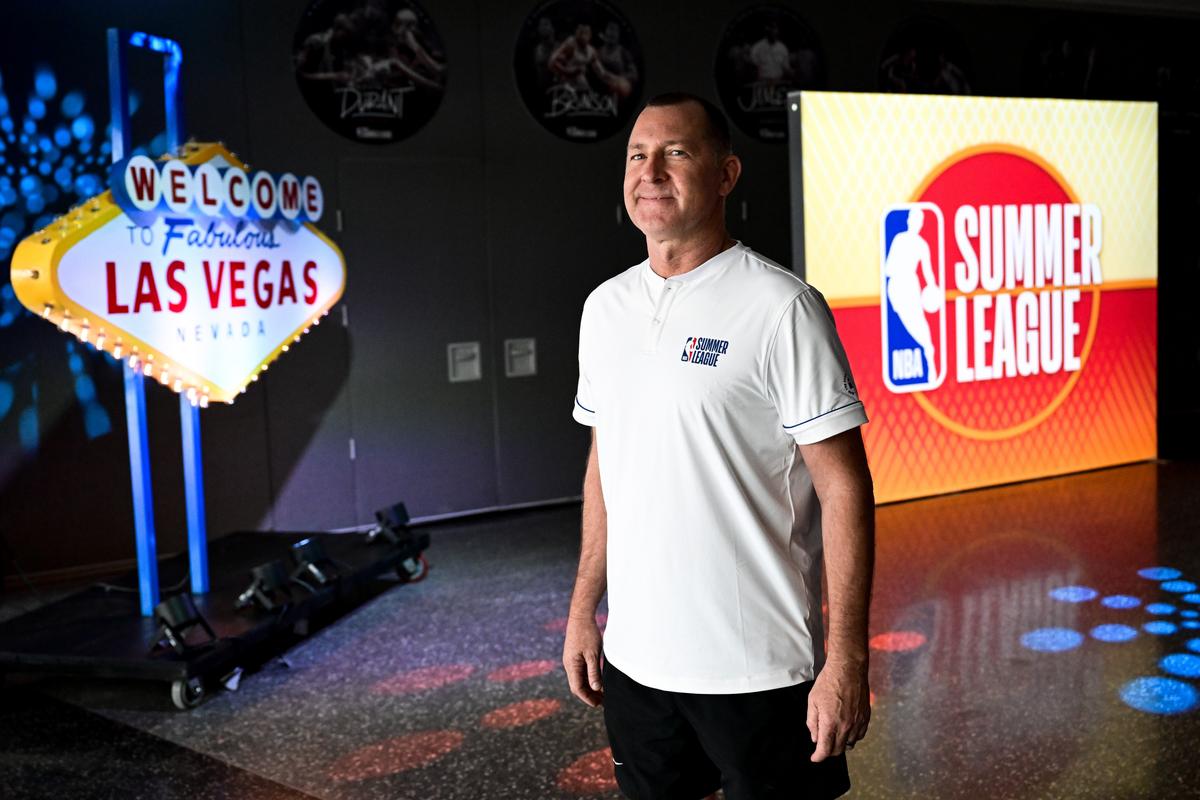
NBA Summer League co-founder Albert Hall, a 1991 graduate of Washington State University, poses for a photo during a Summer League on Tuesday, Jul 14, 2026, at the Thomas & Mack Center in Las Vegas, Nev. (Tyler Tjomsland / The Spokesman-Review)
LAS VEGAS – Albert Hall’s daily schedule at NBA Summer League is busy enough, and that’s before you factor in the different fires he’s extinguishing from the time he wakes up until he finally shuts his eyes, usually an hour or two past midnight.
Metaphoric fires, of course, but when you hear what the average day looks like for Hall and everything it encompasses, you might believe either possibility.
For example, the evening portion of Hall’s agenda on July 13 begins when he’s called to help with a medical emergency. He doesn’t disclose what transpired, but it required a 911 call and ambulance dispatch to the area on UNLV’s campus that’s become a summer hoops mecca for NBA players, coaches, owners, general managers, staff members, scouts, fans and virtually anyone else who wants a piece of what Hall and Vegas Summer League co-founder Warren LeGarie have built over the last two decades.
Moments after the ambulance leaves, another crisis has Hall’s attention. A group of fans is trying to get into Thomas & Mack Center with artificial tickets. Hall can’t count the number he’s confiscated over the years.
Next, he’s meeting with an unnamed NBA owner who’s looking to book court time for his kid to practice the next morning. Then it’s off to dinner at the Palms Casino Hardwood Suite. Hall doesn’t eat, of course – too busy connecting, networking, schmoozing – so by the time he’s finished up at the Palms, he still has to find a meal for himself. Hall returns to his hotel room, responds to e-mails and hits the pillow sometime between 12:30-1 a.m., anticipating a 6:30 a.m. wakeup call the next day.
This is merely what the fifth night at 2026 Vegas Summer League looks like for Hall, a Tacoma native who graduated from Washington State University’s Murrow School of Communication in 1991. If he also had to walk through the morning and afternoon, it would require an additional 30 minutes Hall simply doesn’t have in his day.
“An average day for me is kind of insane,” he said. “… When the ball goes up, it’s like phew, sigh of relief, we’re playing. Then a whole new series of problems start.”
It comes with everything Hall and LeGarie have built at Vegas Summer League, which continues to shatter attendance, television rating and merchandise records in its 22nd year of existence.
Earlier this month, the two-week event reported 156,000 total attendees, signifying a 12% increase from the year prior.The championship game, which pitted Washington State’s Cedric Coward and the Memphis Grizzlies against Gonzaga’s Graham Ike and the Golden State Warriors, set a new record with 676,000 average viewers on ESPN. Vegas Summer League also saw an 11% increase in merchandise sales from the previous record in 2024.
“We’ve got to continue to move the needle,” Hall said. “We freshen things every year. As (NBA Commissioner) Adam (Silver) says…the Vegas Summer League is our 31st franchise, and we run it that way.”
**• • •**Growing up on the east side of Tacoma, Hall, a former wrestler at Bellarmine Prep, followed in his sister’s footsteps, attending WSU in the fall of 1997. The Cougars were phasing out of the Timm Rosenbach era on the football field and entering the Drew Bledsoe era. The basketball program was in good hands with new coach Kelvin Sampson and the Greek system, in Hall’s words, was “on fire.”
Hall savored his time in Pullman and didn’t have firm plans after graduation until he and a friend attended a job fair, where a representative from Harvey’s Casino in Lake Tahoe, Calif., enticed them with a $1,000 bonus if they fulfilled a monthlong employment obligation. It sounded like a dream to Hall, an avid skiier, mountain biker and fisherman who couldn’t pass up on the outdoor splendors of Tahoe and a steady paycheck. He and his friend stuffed their things into a U-Haul truck and started on the 13-hour drive from Pullman.
“We show up and we’re like, we’re here,” Hall said. “They’re like, who the hell are you guys?”
Hall worked different casino jobs, carrying change and staffing the sportsbook before eventually going to card dealer’s school. Dealing cards didn’t sound like a sustainable or healthy long-term plan, so Hall left Tahoe and moved home to the Northwest where he picked up a job with the NBA’s SuperSonics, working on the game-night staff under legendary public relations director Cheri Hanson, now with the Portland Trail Blazers.
He climbed the ladder, ultimately landing a front desk job that allowed him to interact with players, owners, coaches, etc. One morning, Hall of Fame Sonics coach George Karl asked for a favor. Karl’s agent was flying in from San Francisco and needed a lift from the airport.
Karl didn’t disclose flight details or anything that could’ve been helpful to Hall, just the following: “He’s going to be wearing a Hawaiian shirt.”
That was Hall’s introduction to LeGarie, who’s considered one of the NBA’s top power brokers for his work representing players, coaches and front office personnel – everyone from late Yugoslavian star Drazen Petrovic, to longtime NBA coach Mike D’Antoni, to current Golden State Warriors General Manager Mike Dunleavy Jr.
“Obviously it was a meeting I never forget,” LeGarie said of the initial interaction with Hall.
When LeGarie spawned the idea to launch a Summer League event in Vegas, the first person he contacted was Stu Jackson, the current West Coast Conference Commissioner who worked then as the NBA’s Executive Vice President of Operations. The next number he dialed was Hall’s.
“I made the first call and I said, you willing to take a risk, a little chance with me?” LeGarie said. “I don’t know what it’s going to be, I have no idea how it’s going to end up but we’re going to have a lot of fun.”
The partnership is now going on more than two decades. Usually too busy with individual obligations, Hall and LeGarie don’t see much of each other during Summer League – even if they’re in the same arena – but daily phone calls allow them to stay connected, coordinate ideas and solve problems.
“He’s very smart, he knows what he’s doing and he makes me look better than I am,” said LeGarie, who resides in Costa Rica full-time, only traveling to Vegas for NBA-related obligations. “Albert does all the work, I take all the credit.”
**• • •**Summer League events had already been running in Boston, Utah, Orlando and Long Beach, Calif., when LeGarie and Hall proposed the Vegas concept in 2004, vowing to put on a better spectacle than their peers across the country.
Boston’s event ran into a big hurdle the year prior, when a rookie LeBron James was entering the league. Event planners didn’t secure hotel rooms far enough in advance and were out of options after the Democratic National Convention booked every vacant hotel block in the area.
“It could always just be done so much better, more professional, more proficient,” Hall said.
Late NBA Commissioner David Stern greenlit the proposal and the co-founders went to work recruiting NBA teams that would agree to make Vegas an annual stop on their offseason circuit.
“First year I joke, but we had six handshakes, we finally got six teams to do it,” Hall said. “Six handshakes and box of fliers and inflatable people in the stands just to make it look full.”
The inflatable fans may be an exaggeration, but Hall and LeGarie did lure local kids camps with free tickets to fill the bleachers and present the illusion of a packed arena. Early on, they’d situate the majority of fans on one side of Cox Pavilion – the smaller, auxiliary gym connected to UNLV’s primary Thomas & Mack Center – to make their product look better on television.
The co-founders were able to negotiate a cost-friendly deal for the venue because of a pre-existing relationship with late musical agent Chip Hooper, who represented Dave Matthews Band, Coldplay, The Black Eyed Peas and others. One of Hooper’s clients, American rock band Phish, sold out a concert at UNLV and arena officials were looking to get two more dates on the calendar. Hooper obliged, but only if they’d include the inaugural Summer League into the package.
“We got Cox Pavilion in the deal,” Hall said.
To avoid a crisis similar to the one Boston experienced the year before, Hall made sure he had lodging secured for each of the visiting teams. He drove to the popular New York-New York Hotel Casino on the Vegas Strip with an outside-the-box idea that included a literal shoe box and size 21 sneaker.
“We’re trying to get our foot in the door,” Hall said, presenting the shoe box before delivering his proposal.
The co-founders added six more teams to reach 12 the next year, followed by 18, then 24 and finally all 30. As interest in the product heightened, Hall and LeGarie launched a website, watching internet servers crash as thousands of fans raced to find box scores.
In LeGarie’s opinion, the game-changing, eye-opening moment for Vegas Summer League arrived in 2008. Turner Sports had reached an agreement to control NBA TV properties and indicated it wouldn’t broadcast Summer League, potentially halting all of the momentum and buzz LeGarie and Hall manufactured the previous four years.
Hall’s solution was to create a pay-per-view service. Costs on the front end would be hefty, but LeGarie agreed it was a risk the partners needed to take if their product would have any longevity.
“We can’t be dark, not in this situation,” LeGarie said. “We’ll live in a bubble here and we’ll kill whatever momentum and we’ll be seen as a minor, minor league.”
As games started tipping off in 2008, Hall and LeGarie still wondered if it was a brilliant maneuver or a brutal mistake. Nervously, they posted up next to computers that tracked pay-per-view purchases in real time.
“We’re standing next to each other and there’s nothing more beautiful than the sound of pay-per-view when people are buying it,” LeGarie said. “It starts off with one ding…ding, ding…ding, ding, ding, ding…ding, ding, ding, ding, ding. Albert and I were looking at each other and I didn’t put a tongue down his throat, but I almost did and a big kiss. In that moment, we realized we’re not a ‘why’ league, we’re a ‘why not’ league.”
**• • •**With simultaneous games happening at Thomas & Mack Center and Cox Pavilion earlier this month, Hall reflected on the past 20-plus years of growth and transformation at Summer League from a couch inside a large conference room at Thomas & Mack Center. Hours later, Silver would give his annual state-of-the-NBA address from a podium nearly 50 feet away, addressing expansion topics that could impact two of the cities that have influenced Hall’s life in a profound way.
A lifelong fan and former Sonics employee, Hall is confident Seattle has the infrastructure and loyalty to support another NBA franchise. After returning to the Emerald City, Hall and Karl partnered to launch the Friends of Hoop AAU program. Dozens of prominent NBA and college standouts came up through the grassroots organization, including Jamal Crawford, Nate Robinson, Isaiah Thomas, Zach LaVine and former Gonzaga wing Corey Kispert.
“Seattle, it ebbs and flows. There’s no doubt,” Hall said. “It goes through its period of correctness and all that stuff and then it’s like hey, what are we doing with this? Then it seems to correct itself and now I think it’s in another one of those states. I think the city’s really ready for it. There’s just a lot of proud fans, it’s just a great basketball city.”
The NBA is also focused on Vegas as a potential expansion site – something that could bring even more eyeballs, attention and opportunities to Summer League.
“There’s got to be a new venue built at some point,” Hall said. “What’s that footprint look like, does it incorporate Summer League? Those are the things we’re vetting through and obviously Adam’s been our guiding light the whole time, he’s supported everything we’ve done.”
Hall juggles a handful of ventures outside of Summer League. A Southern California resident, he helped UC Irvine design its baseball stadium and also co-operates an arcade, Balboa Fun Zone, in Newport Beach.
Another passion? Looking out for and helping his alma mater in any way possible.
Hall owns an RV pass and gets back to Pullman once or twice every fall to catch the Cougars. Eventually, he hopes to work with the school on Beasley Coliseum renovations. A few years ago, Hall stumbled into new WSU basketball coach David Riley during a pregame football tailgate and encouraged Riley’s coaching staff to travel to Vegas for Summer League.
It’s transformed into much more than that. Each of the last two years, a group of WSU fans have joined Riley and his staff in Vegas for a one-of-a-kind experience that helps support the program’s NIL (Name Image Likeness) and revenue sharing. Fans donate $2,500 to WSU to secure a spot on the three-day trip and Hall, who has dozens of connections throughout Vegas, covers Summer League tickets, hotel rooms, dinners and other experiences.
Among other unique opportunities, the group that traveled this year had a chance to meet former WSU player Cedric Coward after a Memphis Grizzlies Summer League practice at Resorts World.
Recounting his first-ever conversation with Riley, Hall remembered the WSU coach sharing his admiration for D’Antoni, who pioneered the vaunted seven-seconds-or-less offense. During a Summer League game earlier this month, Hall convinced a guest to visit the suite where Riley and the WSU contingent were sitting.
“I brought (D’Antoni) up to the suite…David was like dude I’ve read his book, that’s my guy,” Hall said. “Then later I walk him up and we got a couple minutes with Kevin Garnett, so he and KG are talking hoops because KG and I are partners on their film festival.”
Hall didn’t have much time to decompress when Summer League finished July 19. His company, HallPass Media, partners with Jalen Brunson’s charity, Second Round Foundation. The NBA champion New York Knicks guard is hosting his fourth-annual golf tournament on Aug. 10 in Westchester, N.Y. As of this month, 288 golfers and 800 dinner guests were confirmed, according to Hall.
“This year it’s going to be bananas,” Hall said. “The (New York City) mayor (Zohran Mamdani) hit us. It’s big time. We get everybody from Mariska (Hargitay) and Edie Falco and Spike Lee. We’re trying to get (Timothee) Chalamet and (Ben) Stiller and all those guys.”
After the golf tournament, Hall has one more obligation before a break in the summer schedule. His daughter is leaving for college. Hall gave his best sales pitch for WSU, but it was the perhaps the one deal he couldn’t close.
“She liked Washington State, got in there,” Hall said, “but Baylor was her number one.”