The story of the afternoon at the Amex is intriguing as **Brighton** ended **Arsenal’s** perfect **Premier League** start with a 3–0 win.
Arsenal came into the game having won their first four league matches and conceded only once. But Brighton’s pressing, energy and ability to punish mistakes exposed problems that Arsenal had not faced in the same way during their opening games.
Arsenal still had the majority of possession and completed more passes, but the ball was often moved around areas where Brighton were comfortable defending. Brighton, meanwhile, made better use of the moments when they won possession.
Possession Without Enough Threat
--------------------------------
Arsenal’s 4-2-3-1 gave them a strong base to control the ball, but Brighton made it difficult for them to turn that possession into clear chances.
Brighton did not simply sit deep and wait for Arsenal. They pressed from the front and regularly put pressure on Arsenal during the build-up.
This forced Arsenal to play backwards or sideways more often than they would have wanted. Their defenders could have the ball, but finding a clean pass into midfield or the attacking players was much harder.
Arsenal therefore had plenty of possession without creating enough danger from it.
That was one of the biggest differences between the two teams.
Brighton’s Press Caused Problems
--------------------------------
Brighton were aggressive whenever Arsenal tried to build from the back.
Their midfield and attacking players worked together to close passing options and make Arsenal’s players make decisions quickly. When Arsenal did manage to move the ball forward, Brighton were often able to recover their shape and protect the middle of the pitch.
This meant Arsenal struggled to find the space between Brighton’s midfield and defence.
The problem was not that Arsenal could not keep the ball.
The problem was that they could not consistently use the ball to move Brighton’s defence around and create good opportunities.
Arsenal’s Defensive Mistakes
----------------------------
Brighton’s first two goals also showed moments where Arsenal could have defended better.
**Pascal Groß** opened the scoring in the 31st minute with a strike from outside the box. Arsenal gave him enough room to get the shot away, and the ball found the net.
Then, just before half-time, **Charalampos Kostoulas** doubled Brighton’s lead with another finish from distance.
Neither goal was a huge chance in terms of expected goals, but that does not remove the defensive issue. Arsenal allowed Brighton’s players enough time and space to attempt those shots.
Against a team playing with Brighton’s confidence and intensity, those small mistakes can become very costly.

Arsenal's Gabriel Magalhaes in action during the 2026/27 Premier League clash between Brighton & Hove Albion and Arsenal FC at the American Express Stadium in Brighton, England, on September 19, 2026. (Photo by Pedro Porru/MB Media/Getty Images)
The Third Goal Finished the Game
--------------------------------
Brighton made it 3–0 in the 57th minute.
Groß delivered a corner, and **Chema Andrés** rose to head the ball into the net.
At that point, Arsenal had a mountain to climb. Brighton could now defend their advantage while Arsenal had to take more risks going forward.
The third goal also showed the importance of set pieces. Arsenal’s organisation on that corner was not good enough, and Brighton took full advantage.
However, it would be too strong to call this proof of a long-term set-piece weakness based on one match. It was simply another area where Arsenal were punished on the day.
**The Numbers Need Context**
----------------------------
The statistics make the result even more interesting.
Arsenal had more possession and produced a similar, or slightly higher, expected-goals figure depending on the data provider. Yet they only managed two shots on target, while Brighton put five on target.
That tells us something important.
The match was not simply a case of Brighton creating chance after chance while Arsenal did nothing.
Instead, Brighton were much more effective with the important moments.
Arsenal’s possession did not produce enough clear chances, while Brighton took advantage of the opportunities they created.
**The Bigger Problem: Intensity**
---------------------------------
The biggest lesson for Arteta is not that possession is useless.
It is that possession needs to lead somewhere.
Arsenal can control the ball for long periods, but if they cannot break through an organised press, their possession becomes much less dangerous.
At the same time, Arsenal need to be aggressive when they lose the ball. Brighton showed how quickly a team can punish even small gaps or moments of hesitation.
That was something Arsenal had done very well during their opening four league games. At Brighton, they were not at the same level.
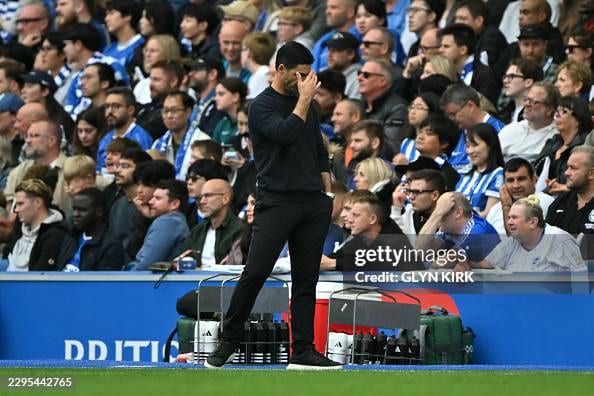
Arsenal manager Mikel Arteta reacts from the touchline during the English Premier League match between Brighton & Hove Albion and Arsenal at the American Express Community Stadium in Brighton, southern England, on September 19, 2026. (Photo by Glyn KIRK / AFP via Getty Images)
**What Arteta Needs to Fix**
----------------------------
The international break gives Arteta time to look at several things.
Arsenal need better solutions when opponents press them aggressively. They also need to improve how quickly they react when possession is lost and make sure their defensive organisation remains strong during set pieces.
Most importantly, Arsenal need to make their possession more dangerous.
Having 60 per cent of the ball means very little if most of it happens away from the areas where chances are created.
Brighton showed the other side of the game.
They had less of the ball, but they pressed with greater intensity, punished Arsenal’s mistakes and made their important moments count.
Arsenal controlled possession.
Brighton controlled the moments that decided the game.
And that is why the champions left the Amex with a 3–0 defeat.