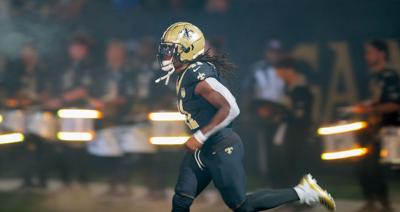
New Orleans Saints running back Alvin Kamara (41) takes the field at the Caesars Superdome in New Orleans, Sunday, Sept. 27, 2026. STAFF PHOTO BY DAVID GRUNFELD
STAFF PHOTO BY DAVID GRUNFELD
In a recent sit-down interview with NBC’s Jason Garrett, Denver Broncos coach Sean Payton reminisced about his time coaching [Alvin Kamara](https://nola.com/tncms/asset/editorial/145b2b66-f4ad-4de1-9667-4d38b34e6843).
When he was with the Saints, Payton found that the running back tended to get bored. Kamara, as talented as he was, could coast in practice, occasionally leading to him dropping an easy pass. So one day, the two had an honest conversation — spurred on by a text message the night before in which Payton asked Kamara if he could coach him hard.
Payton began the dialogue with a question: Did Kamara see himself making the Hall of Fame one day? According to Payton, Kamara answered yes.
“I said, ‘All right, well, I don’t think your trajectory right now is steep enough to make that goal happen,’” Payton said. “I think your trajectory is five Pro Bowls, a couple All-Pro teams, phenomenal career, all-time leading rusher, but I think your trajectory, and I think your practices have to be (better).”
Weighing in on social media, Kamara said it was a true story and that he was “forever grateful.” But he also wanted to make one thing clear.
“He always knew that when it was time to lock in, I was ready though,” Kamara wrote, adding a laughing emoji.
Payton may no longer be with the Saints. But once again, it is time for Kamara to lock in.
With Travis Etienne landing on injured reserve with a hamstring injury, Kamara is suddenly poised to return to his role as New Orleans’ starting running back. This wasn’t the spot either he or the Saints envisioned when they haggled for months over his contract, ultimately leading the 31-year-old to take a $5.5 million pay cut.
But the Saints kept Kamara for a reason. New Orleans could have moved on, but chose to bring back its all-time leading rusher. The driving factor went beyond what it would mean for Kamara to finish his career in New Orleans. The reason went beyond the idea that the running back could be arguably more effective in a reduced role.
The Saints brought Kamara back because they still believed he had enough left in the tank to contribute.
“Listen, if you can’t play on the field, then they can’t play,” Saints general manager Mickey Loomis said in July. “It’s that type of business.”
The Saints’ actions since have reiterated that belief. After a competitive training camp, New Orleans let go of talented running backs such as Devin Neal and Audric Estime — first stashing them on injured reserve before waiving them with a settlement. Then when the season began, Kamara’s usage was higher than many anticipated.
After missing New Orleans’ season opener with a knee injury, Kamara returned to play 29.4% and 32.4% of the snaps. But within those numbers, he had more carries than Etienne in a Week 2 win over Baltimore and while that was on pace to correct itself a week later, Etienne then got hurt.
“Very few times in this league is one running back going to haul the load,” coach Kellen Moore said. “That’s just what this league is.”
But the question remains how effective Kamara can still be. Last season, he was statistically one of the league’s worst running backs. The 2017 third-rounder not only put up career lows in several categories (yards, yards per carry), but he ranked near the bottom of the league in advanced categories like rushing yards over expected and rushing yards after contact. That was even with Kamara missing the last six games because of an injury.
Still, the Saints struggled to run the ball as a team. Were the stats a sign of Kamara’s decline — or a team that couldn’t block properly? Kamara, too, was coming off a resurgent 2024 when he seemed to thrive in then-offensive coordinator Klint Kubiak’s outside zone scheme.
The early returns this season haven’t provided an answer. In his season debut, Kamara averaged only 1.7 yards per carry — but that was a game in which New Orleans again couldn’t generate much on the ground. Last week against the Las Vegas Raiders, Kamara’s numbers improved — a respectable 4.0 yards per carry — but finished with 6 fewer yards than expected, according to Next Gen Stats.
Teammates continue to voice confidence in his abilities. Guard David Edwards has only been with the Saints this season, but he saw what Kamara was still capable of last season when New Orleans gave a spirited effort against the Buffalo Bills. From the other sideline, Edwards saw a team that controlled the line of scrimmage — and a premier running back who capitalized on those holes.
Edwards’ appreciation has only grown over the last few months, having gotten to know the running back.
“Alvin’s one of the smartest players I’ve ever been around,” Edwards said. “His library of football is obviously so vast that when you talk to him about a certain play or a certain look, he’s able to recall, maybe a play, a cut or a situation that he’s already experienced.”
That library can take people by surprise. For about the first year and a half of his career, Kendre Miller admitted he had a tough time following whenever Kamara brought up “a look from 2018” or some other random year and dove into the details.
“He can pretty much see the play happen before it happens,” Miller said.
Can Kamara’s legs match what his eyes see?
If they can’t, the Saints and Kamara might need another honest conversation.